How could a wakizashi complement your main product range and boost upsells?
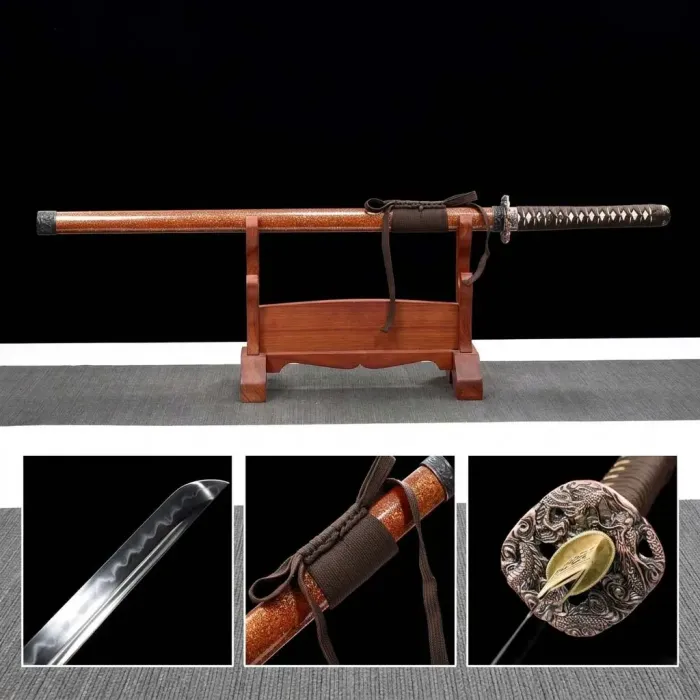
That age-old ancient blade functions as a stunning work of art, but consider if you desire to communicate your individual character? Refining your armament is a fulfilling journey, allowing you to create a truly uncommon piece. From the handle wrapping and fastening to the tsuba design and cutting motif, each element offers a chance for tailored look. This investigation delves into the sphere of katana refinements, providing details for both initiates and experienced enthusiasts pursuing to establish their mark on the time-honored art of the samurai.
Primary Genuine Workmanship
For beginners eager to embark on the gratifying journey of Japanese swordsmanship , 1060 steel katanas deliver an prime entry point. This specialized grade of structural steel achieves a ideal mix between low price and functionality . While less than hard as elite steels, 1060 provides a reasonable level of edge development , making it ideal for starters to cultivate the preliminaries of sword maintenance and experience the grace of genuine Japanese weaponry. It’s a superb choice for fostering experience without the fiscal burden of more premium steels.
T Gear Steel Cutlasses: Combining Potency and Affordability
For enthusiasts seeking an authentic sword experience without exceeding the budget , T10 steel katanas represent a promising option. These weapons offer a significant improvement in durability compared to middling alternatives, exhibiting reasonable edge retention and satisfactory flexibility for initial hacking techniques. While not rivaling the excellent characteristics of advanced steels like T100 or folded material , T10 provides a worthwhile blend of performance and value , making them a well-liked choice for trainees and those on a restrained income .
Going past the Sharpness : Adapting Your Blade's Hardware and Hold
Considering the buffed sword is undeniably the central point of a katana, truly enriching its elegance lies in the cautious customization of its hardware and grasp . This method allows collectors to present their exclusive preference . Assess the ample possibilities: menuki - decorative adornments that introduce visual detail ; the hamon enclosures – often intricately molded ; the tsuka basis itself, wrapped in authentic ito string ; and the fusa knob , which can be designed from various resources like precious metals or cartilage .
- Opt for ideas that harmonize with you.
- Delve into with assorted mediums.
- Stress quality for a persistent impression .
The Allure of the Katana: History, Craftsmanship, and Steel
This traditional armament bears a unparalleled allure, steeped in centuries of oriental history and practice . More than merely a tool of fighting , it's a figure of the warrior ethos – a fusion of dexterity and rule. Its evolution spanned various generations, with early cutting tools evolving into the elegant curvature and fatal edge we accept today. The craftsmanship involved is truly astounding , requiring ages of coaching to master . The process involves a involved folding of smelted iron , creating layers that fortify the blade's flexibility and severing ability. Diverse schools of fabricating came about , each with their own secrets and methods for achieving the optimal symmetry and definition - a truly exacting pursuit.
- Preliminary Katana designs
- The role of the Japanese sword in bushi culture
- Classic crafting styles
Opting for the Optimal Steel for Your Oriental Blade Project: 1060 vs. T10
Determining the fitting steel is crucially important for any oriental blade project, and the resolution between 1060 and T10 can be delicate. 1060 is a well-known American composition, custom katana offering a solid balance of robustness and fortitude, enabling it reasonably easy to handle. However, T10, a East Asian steel, frequently boasts improved wear longevity and can arguably achieve a greater ultimate hardness, although it can be more tough to treat and requires exact heat conditioning. Consider your proficiency and targeted effects: for a first-timer, 1060 may be a easier starting point, while the expert smith might admire the augmented attributes of T10.
- Effortlessness of Processing
- Edge
- Maximum Stiffness
Unlocking the Potential: Advanced Katana Customization Techniques
Excelling in the craft of sword improvement extends far beyond basic grinding. Serious practitioners are now exploring advanced techniques to truly discover a blade's hidden potential. This requires intricate work with the temper line, utilizing specialized resources for differential heat treatment and carefully selecting the configuration of the guard to optimize balance and operation. Beyond purely functional refinements, artisans are increasingly focused on creating unparalleled aesthetic magnificence, through complex incising and layered varnishes that truly transform a katana into a magnum opus.
Shaping Rough Steel into Perfection: Making a 1060 Sword
The journey starts with average 1060 metal , a solid material far distant the fine katana it will evolve . Accomplished bladesmiths use a detailed process of combining and forming the crude steel, repeatedly burning it and hammering it to discard impurities and build a even grain structure. This tiring process, often lasting for periods , builds the fundamental resilience and malleability characteristic of a true Japanese saber . Supplementary heat treatments , including exact hardening and setting , are critical to achieve the sought-after proportion of sharpness, stability and grace .- Combining: Diminishes impurities and creates grain structure.
- Molding: Molds the steel into the initial blade form.
- Hardening: Determines the final hardness and flexibility.
The Durable Charm of the Katana: Intensive Inspection of Steel and Adaptation
A historic katana continues a intense symbol denoting Japanese culture , its allure far exceeding mere armaments . Forged from rare steel and habitually featuring intricate details , the system of creation itself is a sacred art. Beyond the basic craftsmanship, the ability to customize a katana - from the blade pattern to the grip wrapping and band - permits for a perfectly individual manifestation for both supporters and operators alike. This union of legacy steelwork and boundless personalization brings the katana's continued presence across the terra .